淀粉广泛用于加工粉条、米粉、凉皮、凉粉等传统淀粉类凝胶食品。淀粉凝胶的质构特性、营养特性和贮藏稳定性直接影响淀粉类凝胶食品的品质。添加多糖是目前改良淀粉凝胶结构的手段之一,兼备方便、高效、价格低廉、环境友好等特点,大量多糖(如黄原胶、瓜尔胶、仙草多糖、β-葡聚糖、食用菌多糖等)已被证实可以有效调控淀粉凝胶结构,提升凝胶的贮藏稳定性以及营养价值。例如陈忠秋等[1]将香菇β-葡聚糖替代20小麦淀粉,体系快速消化淀粉含量降低44.7%,抗性淀粉含量提升45.8%,预测血糖指数降低32.3%。κ-角叉菜胶、魔芋胶、仙草多糖也被研究发现通过与浸出的直链淀粉分子相互作用从而提升木薯淀粉凝胶强度[2]。YAN等[3]研究发现麦麸阿拉伯木聚糖可显著降低小麦淀粉凝胶体系贮藏14 d后的淀粉老化焓,对淀粉回生具有明显阻碍作用。在对淀粉和多糖共混体系的研究中,目前仍缺乏多糖影响淀粉凝胶特性的规律总结及机制分析,这对于食品工业中淀粉类凝胶产品品质提升尤为重要。本文从淀粉凝胶特性的3个方面(质构特性、消化特性、贮藏稳定性)出发,总结了近10年来多糖对淀粉凝胶品质的调控进展及工作机制,并对其未来发展方向进行探讨,以期推动多糖在淀粉凝胶结构增强以及产品品质提升中的深入研究和应用。
1 多糖对淀粉凝胶质构特性的调控及机制
凝胶的质构特性主要取决于淀粉-多糖复合凝胶网络结构特征,通过物性分析仪(texture profile analysis,TPA)来模拟口腔的咀嚼行为从而对凝胶的硬度、弹性、咀嚼性等指标进行精确测量。表1总结了近10年研究报道的多糖对淀粉凝胶质构特性的调控效果。
表1 多糖对淀粉凝胶质构特性的影响
Table 1 Effect of polysaccharides on texture properties of starch gel
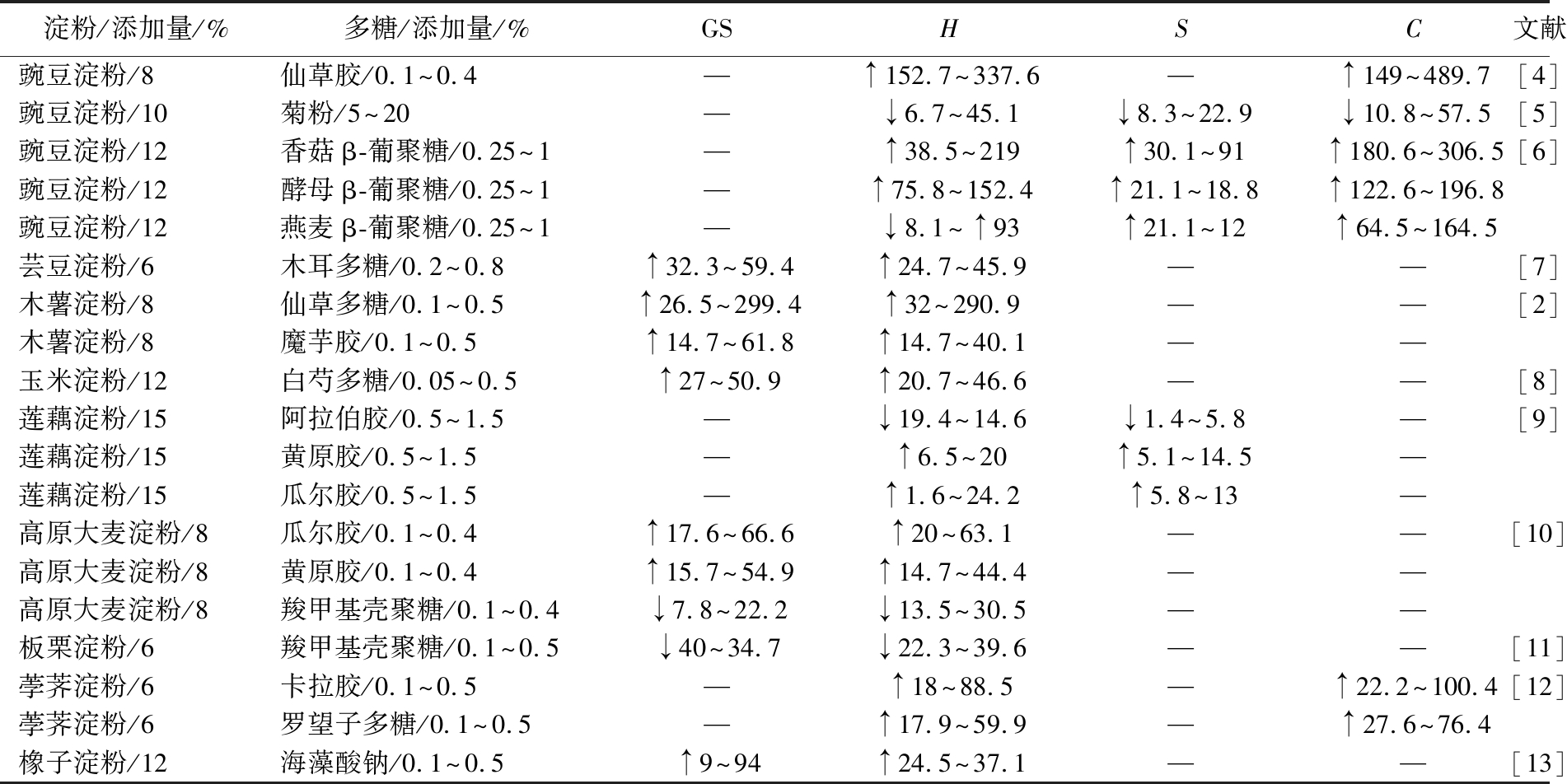
注:表格中淀粉和多糖的含量均表述为体积分数;GS为凝胶强度(gel strength),H为硬度,S为弹性,C为咀嚼性;↑表示该指标随多糖添加而升高,↓表示该指标随多糖添加而降低,—表示文中未涉及该指标,↑和↓后的数值表示相较于对照组升高或降低的百分比(%),是从论文数据直接计算或估计而得(下同)。
淀粉/添加量/%多糖/添加量/%GSHSC文献豌豆淀粉/8仙草胶/0.1^0.4—↑152.7^337.6—↑149^489.7[4]豌豆淀粉/10菊粉/5^20—↓6.7^45.1↓8.3^22.9↓10.8^57.5[5]豌豆淀粉/12香菇β-葡聚糖/0.25^1—↑38.5^219↑30.1^91↑180.6^306.5[6]豌豆淀粉/12酵母β-葡聚糖/0.25^1—↑75.8^152.4↑21.1^18.8↑122.6^196.8豌豆淀粉/12燕麦β-葡聚糖/0.25^1—↓8.1^↑93↑21.1^12↑64.5^164.5芸豆淀粉/6木耳多糖/0.2^0.8↑32.3^59.4↑24.7^45.9——[7]木薯淀粉/8仙草多糖/0.1^0.5↑26.5^299.4↑32^290.9——[2]木薯淀粉/8魔芋胶/0.1^0.5↑14.7^61.8↑14.7^40.1——玉米淀粉/12白芍多糖/0.05^0.5↑27^50.9↑20.7^46.6——[8]莲藕淀粉/15阿拉伯胶/0.5^1.5—↓19.4^14.6↓1.4^5.8—[9]莲藕淀粉/15黄原胶/0.5^1.5—↑6.5^20↑5.1^14.5—莲藕淀粉/15瓜尔胶/0.5^1.5—↑1.6^24.2↑5.8^13—高原大麦淀粉/8瓜尔胶/0.1^0.4↑17.6^66.6↑20^63.1——[10]高原大麦淀粉/8黄原胶/0.1^0.4↑15.7^54.9↑14.7^44.4——高原大麦淀粉/8羧甲基壳聚糖/0.1^0.4↓7.8^22.2↓13.5^30.5——板栗淀粉/6羧甲基壳聚糖/0.1^0.5↓40^34.7↓22.3^39.6——[11]荸荠淀粉/6卡拉胶/0.1^0.5—↑18^88.5—↑22.2^100.4[12]荸荠淀粉/6罗望子多糖/0.1^0.5—↑17.9^59.9—↑27.6^76.4橡子淀粉/12海藻酸钠/0.1^0.5↑9^94↑24.5^37.1——[13]
如表1所示,除羧甲基壳聚糖、菊粉和阿拉伯胶外,多糖(仙草胶、黄原胶、瓜尔胶、β-葡聚糖、卡拉胶、木耳多糖、魔芋胶、白芍多糖、罗望子多糖、海藻酸钠等)都能显著增加凝胶强度、硬度、咀嚼性等,但它们的改善幅度有差异。多糖的电荷情况是影响淀粉凝胶质构特性的关键因素。其中,阳离子多糖羧甲基壳聚糖的添加会弱化凝胶质地,而大多数阴离子多糖和中性多糖与之相反,大幅改善淀粉凝胶强度。特别地,在相同多糖浓度下,阴离子多糖仙草胶大幅提高凝胶强度,赋予淀粉凝胶优异的质构性能。另一方面,淀粉凝胶强度与多糖相对分子质量呈正向相关关系。XIE等[14]的研究发现相比低相对分子质量阿拉伯木聚糖,高相对分子质量阿拉伯木聚糖对凝胶质构特性影响更明显,凝胶硬度随相对分子质量增加而提升。此外,随多糖添加量的增加,淀粉凝胶的强度、硬度及咀嚼性呈现剂量依赖性增强。然而,部分多糖因其独特的结构和性质,在淀粉凝胶体系中会形成质地更加柔软的凝胶。例如,HAN等[9]发现阿拉伯胶会降低莲藕淀粉凝胶的硬度,减弱凝胶强度。这归因于阿拉伯胶高度支化的球形结构,与直链淀粉分子间相互作用较弱。JI等[5]的研究表明随着菊粉添加量的增加,豌豆淀粉凝胶的硬度、弹性和咀嚼性显著下降。其主要原因可能是研究中大量添加具有强吸湿性的菊粉,与淀粉竞争水分,导致淀粉颗粒吸水溶胀受限,淀粉颗粒聚集,体系相容性较差,且菊粉分子间的作用强度弱于直链淀粉分子链之间的相互作用,因此淀粉凝胶硬度降低。总体而言,多糖的改善效果与其电荷情况、相对分子质量以及添加量密切相关。
多糖调控淀粉凝胶质构特性的作用机制具体解释如下:a)阳离子多糖通过静电相互作用吸附聚集到淀粉颗粒表面,抑制直链淀粉溶胀和浸出,难以形成连续网络结构,且阳离子多糖会破坏直链淀粉分子间氢键,因此降低凝胶硬度[11]。阴离子多糖和中性多糖主要通过氢键与淀粉相互作用,提升凝胶强度。此外,阴离子多糖-淀粉体系中还存在微弱的静电力,促进直链淀粉分子链交联。b)高相对分子质量多糖通过增加氢键数量,从而增强与淀粉分子间的相互作用,提升淀粉凝胶硬度[15]。c)在低浓度多糖添加下,淀粉凝胶强度较弱可归因于没有足够的多糖分子与直链淀粉分子相互作用(多糖包裹在淀粉颗粒表面导致直链淀粉浸出减少),网络结构不均匀、孔隙较大;随多糖浓度的增加,多糖-多糖、多糖-淀粉通过氢键相互作用形成均匀致密的网状结构,降低凝胶体系的孔隙率,并且将淀粉分子限制在有限空间内,促进分子链的重排,从而增加凝胶的硬度[16]。d)多糖的高亲水性使得连续相中直链淀粉有效浓度增加、水分活度降低,促进直链淀粉分子之间的缔合,提升淀粉凝胶强度[17]。
2 多糖对淀粉凝胶消化特性的调控及机制
淀粉凝胶的营养特性主要取决于淀粉的消化特性。根据淀粉在人体消化道中水解速率的快慢将其分为快消化淀粉、慢消化淀粉和抗性淀粉。在通常情况下,米粉等淀粉类凝胶食品消化率较高,对于正常人而言可以快速为机体提供能量,但是长此以往,可能增加糖尿病、肥胖症等慢性疾病的发病率。表2汇总了不同多糖对淀粉消化特性的影响。
表2 多糖对淀粉凝胶消化特性的影响
Table 2 Effect of polysaccharides on digestion properties of starch gel
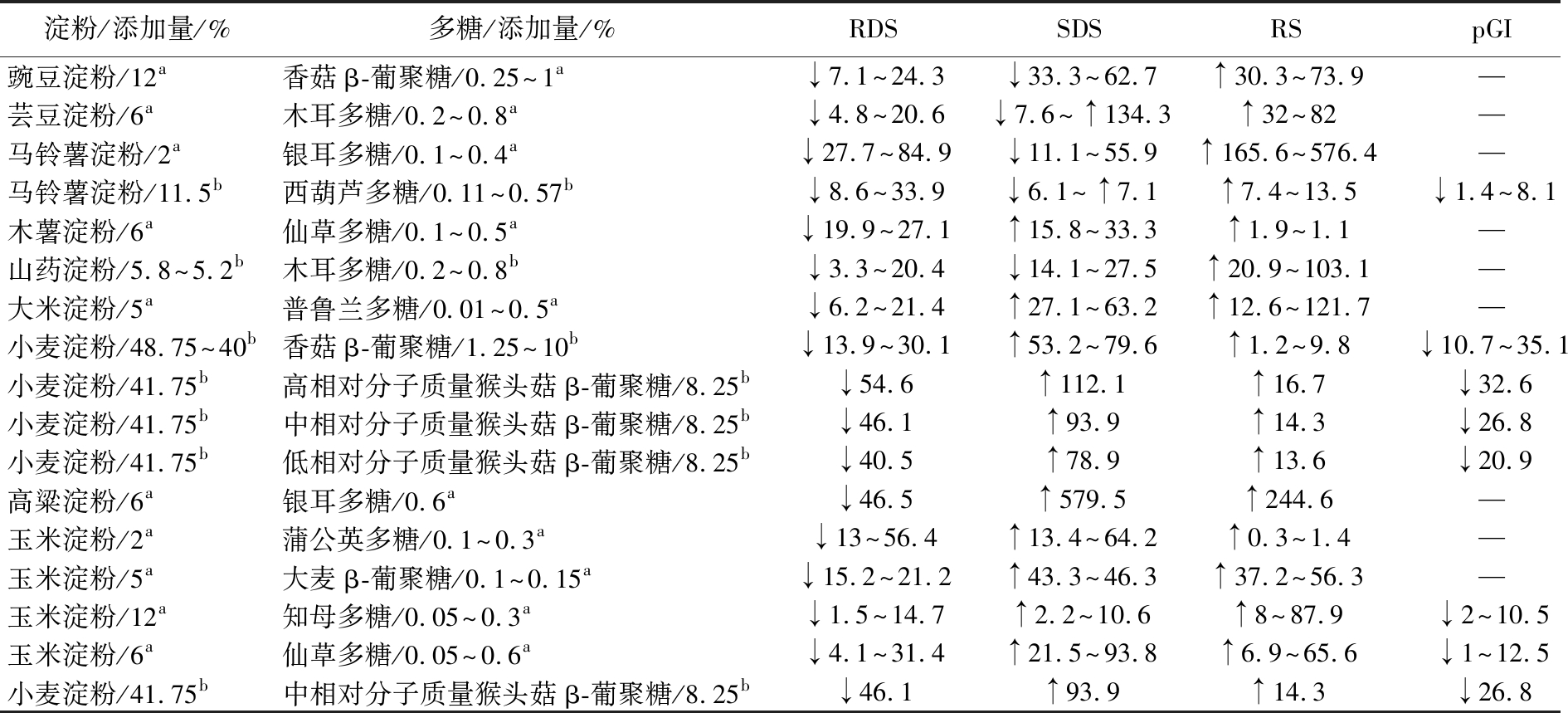
注:表格中肩标字母a代表淀粉和多糖含量表述为体积分数;肩标字母b代表淀粉和多糖含量表述为质量分数(下同);RDS为快消化淀粉(rapidly digestible starch),SDS为慢消化淀粉(slowly digestible starch),RS为抗性淀粉(resistant starch),pGI为预测血糖指数(predicted glycemic index)。
淀粉/添加量/%多糖/添加量/%RDSSDSRSpGI文献豌豆淀粉/12a香菇β-葡聚糖/0.25^1a↓7.1^24.3↓33.3^62.7↑30.3^73.9—[6]芸豆淀粉/6a木耳多糖/0.2^0.8a↓4.8^20.6↓7.6^↑134.3↑32^82—[7]马铃薯淀粉/2a银耳多糖/0.1^0.4a↓27.7^84.9↓11.1^55.9↑165.6^576.4—[18]马铃薯淀粉/11.5b西葫芦多糖/0.11^0.57b↓8.6^33.9↓6.1^↑7.1↑7.4^13.5↓1.4^8.1[19]木薯淀粉/6a仙草多糖/0.1^0.5a↓19.9^27.1↑15.8^33.3↑1.9^1.1—[20]山药淀粉/5.8^5.2b木耳多糖/0.2^0.8b↓3.3^20.4↓14.1^27.5↑20.9^103.1—[21]大米淀粉/5a普鲁兰多糖/0.01^0.5a↓6.2^21.4↑27.1^63.2↑12.6^121.7—[22]小麦淀粉/48.75^40b香菇β-葡聚糖/1.25^10b↓13.9^30.1↑53.2^79.6↑1.2^9.8↓10.7^35.1[23]小麦淀粉/41.75b高相对分子质量猴头菇β-葡聚糖/8.25b↓54.6↑112.1↑16.7↓32.6[24]小麦淀粉/41.75b中相对分子质量猴头菇β-葡聚糖/8.25b↓46.1↑93.9↑14.3↓26.8小麦淀粉/41.75b低相对分子质量猴头菇β-葡聚糖/8.25b↓40.5↑78.9↑13.6↓20.9高粱淀粉/6a银耳多糖/0.6a↓46.5↑579.5↑244.6—[25]玉米淀粉/2a蒲公英多糖/0.1^0.3a↓13^56.4↑13.4^64.2↑0.3^1.4—[26]玉米淀粉/5a大麦β-葡聚糖/0.1^0.15a↓15.2^21.2↑43.3^46.3↑37.2^56.3—[27]玉米淀粉/12a知母多糖/0.05^0.3a↓1.5^14.7↑2.2^10.6↑8^87.9↓2^10.5[28]玉米淀粉/6a仙草多糖/0.05^0.6a↓4.1^31.4↑21.5^93.8↑6.9^65.6↓1^12.5[29]小麦淀粉/41.75b中相对分子质量猴头菇β-葡聚糖/8.25b↓46.1↑93.9↑14.3↓26.8
由表2可知,多项研究证明多糖的添加可以降低淀粉凝胶体系中快速消化淀粉含量,增加抗性淀粉含量,降低预测血糖指数,从而调控淀粉凝胶的消化特性,且大多具有浓度依赖性。同时,多糖相对分子质量越大,体系抗性淀粉含量越多,对淀粉消化特性的影响更明显。多糖对淀粉消化特性的调控是多方面共同作用的结果,可能的机制如下:a)多糖-多糖、多糖-淀粉分子通过非共价相互作用形成聚集体包裹在淀粉颗粒表面,阻碍淀粉酶与淀粉的接触,同时增加消化物的黏度,限制水的流动,减少了包括葡萄糖在内的淀粉水解产物的释放和扩散[22]。b)竞争水分和包裹作用会抑制淀粉颗粒的吸水膨胀,造成淀粉颗粒的不完全糊化,部分淀粉保留与原淀粉颗粒相似的晶体结构,从而降低淀粉消化率[30]。c)多糖竞争水分会增加局部直链淀粉有效浓度,促进双螺旋结构的形成,从而增加其对酶消化的抵抗力[7]。但SASAKI等[31]认为淀粉水解的降低不是由于凝胶结构的增强,更多的是因为体系黏度的增加。综合分析多糖对淀粉消化特性的调控机制,高相对分子质量多糖作用效果更好主要归因于其对体系消化物黏性的显著增加以及与淀粉分子强烈的氢键相互作用。
3 多糖对淀粉凝胶贮藏稳定性的调控及机制
淀粉凝胶的贮藏稳定性主要取决于淀粉的老化特性。淀粉凝胶的长期老化是导致食品品质劣变的主要原因,通常会导致水分流失和硬度增加等问题。凝胶硬度、淀粉老化焓、相对结晶度、老化百分比等可以表征淀粉老化的情况。目前对于谷物淀粉的老化特性研究较多,表3汇总了不同多糖对淀粉凝胶老化特性的影响。
表3 多糖对淀粉凝胶老化特性的影响
Table 3 Effect of polysaccharides on retrogradation properties of starch gel
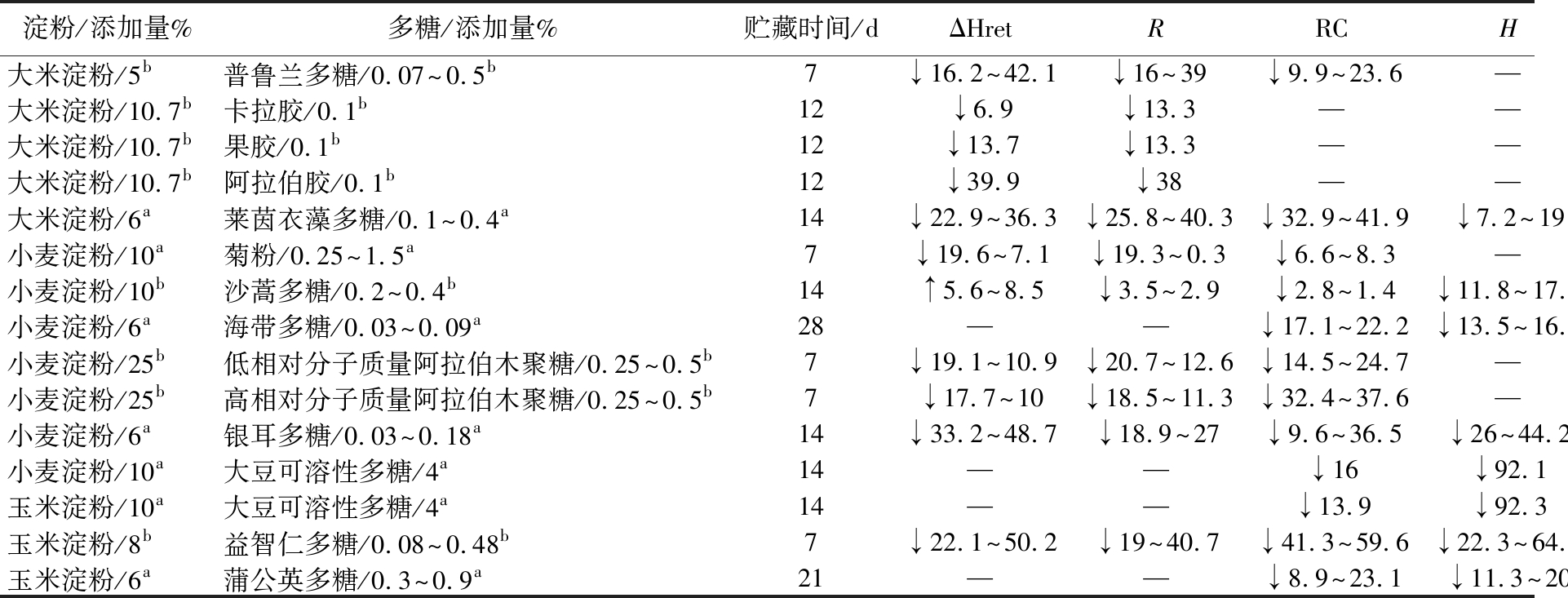
注:ΔHret为淀粉老化焓,R为老化百分比(ΔHret/ΔHgel),RC为相对结晶度(relative crystallinity),H为硬度。
淀粉/添加量%多糖/添加量%贮藏时间/dΔHretRRCH文献大米淀粉/5b普鲁兰多糖/0.07^0.5b7↓16.2^42.1↓16^39↓9.9^23.6—[32]大米淀粉/10.7b卡拉胶/0.1b12↓6.9↓13.3——[33]大米淀粉/10.7b果胶/0.1b12↓13.7↓13.3——大米淀粉/10.7b阿拉伯胶/0.1b12↓39.9↓38——大米淀粉/6a莱茵衣藻多糖/0.1^0.4a14↓22.9^36.3↓25.8^40.3↓32.9^41.9↓7.2^19[34]小麦淀粉/10a菊粉/0.25^1.5a7↓19.6^7.1↓19.3^0.3↓6.6^8.3—[35]小麦淀粉/10b沙蒿多糖/0.2^0.4b14↑5.6^8.5↓3.5^2.9↓2.8^1.4↓11.8^17.1[36]小麦淀粉/6a海带多糖/0.03^0.09a28——↓17.1^22.2↓13.5^16.2[37]小麦淀粉/25b低相对分子质量阿拉伯木聚糖/0.25^0.5b7↓19.1^10.9↓20.7^12.6↓14.5^24.7—[38]小麦淀粉/25b高相对分子质量阿拉伯木聚糖/0.25^0.5b7↓17.7^10↓18.5^11.3↓32.4^37.6—小麦淀粉/6a银耳多糖/0.03^0.18a14↓33.2^48.7↓18.9^27↓9.6^36.5↓26^44.2[39]小麦淀粉/10a大豆可溶性多糖/4a14——↓16↓92.1[40]玉米淀粉/10a大豆可溶性多糖/4a14——↓13.9↓92.3玉米淀粉/8b益智仁多糖/0.08^0.48b7↓22.1^50.2↓19^40.7↓41.3^59.6↓22.3^64.4[41]玉米淀粉/6a蒲公英多糖/0.3^0.9a21——↓8.9^23.1↓11.3^20[42]
由表3可知,在贮藏期间,多糖的作用使得凝胶体系的硬度、淀粉老化焓、相对结晶度和老化百分比基本呈现下降趋势,表明多糖可以抑制淀粉凝胶在长期老化中支链淀粉的重结晶作用,从而提升凝胶的贮藏稳定性。从多糖相对分子质量的差异来看,高相对分子质量多糖显著延缓支链淀粉长期老化,而低相对分子质量多糖主要抑制直链淀粉短期老化。如HOU等[38]在不同相对分子质量阿拉伯木聚糖和小麦淀粉的共混体系中研究发现,贮藏第30天时,2%(质量分数,以淀粉计)高相对分子质量阿拉伯木聚糖显著降低淀粉的相对结晶度(21.96%→14.14%),作用效果最好。另外,多糖对淀粉老化的影响与其分子链的分支程度有关,高度分支的多糖结构能更好抑制支链淀粉的长期老化。FUNAMI等[43]的研究表明半乳甘露聚糖的侧链越多,小麦淀粉的长期(14 d)老化进程越缓慢。除此之外,凝胶硬度与多糖的添加量呈显著负相关关系,可有效改善淀粉凝胶在贮藏期间的失水硬化问题。然而,LUO等[35]在小麦淀粉-菊粉凝胶体系的研究中发现,过量的菊粉可通过其本身分子间相互作用形成晶体,为支链淀粉的重结晶提供晶核,从而加速支链淀粉的重排,整体相对结晶度的降低归因于本研究使用的低聚合度短链菊粉对直链淀粉的重排具有强烈抑制作用。由此可见,多糖对淀粉凝胶贮藏稳定性的影响与其相对分子质量、分支程度和添加量高度相关。
多糖调控淀粉凝胶贮藏稳定性的机制主要有以下几点:a)多糖具有高亲水性可以有效地吸收水分,降低淀粉分子链的流动性,并使得淀粉分子链形成氢键的可用水分减少,从而延缓支链淀粉的重结晶[32]。b)多糖与淀粉分子通过氢键作用和相互缠绕,阻碍淀粉分子链之间的相互作用,降低凝胶体系相对结晶度[44]。c)高相对分子质量多糖主要与支链淀粉相互作用,抑制支链淀粉重结晶;低相对分子质量多糖通过插入直链淀粉分子内部,增加淀粉链之间的距离,削弱淀粉双螺旋内链间氢键的强度,从而抑制淀粉结晶区域双螺旋结构的形成,延缓淀粉老化[45]。d)多分支结构的多糖通过穿插于支链淀粉分子之间,形成缠绕阻隔作用,减缓了支链淀粉分子的重结晶作用,提升凝胶长期贮藏的稳定性[33]。
4 多糖在淀粉类凝胶食品品质调控中的应用
淀粉类凝胶食品是一类以禾谷类、薯类、豆类等淀粉为主要原料经熟化和老化形成的具有一定黏弹性的凝胶体。
其品质的关键在于稳定的凝胶网状结构、较低的淀粉消化率以及良好的抗老化性能。得益于多糖对淀粉凝胶模型的广泛研究,各研究学者将多糖用于提升粉条、米粉、凉粉、凉皮等淀粉类凝胶食品品质。表4总结了近10年来多糖在淀粉类凝胶食品品质改良中的应用。
表4 多糖对各类淀粉凝胶食品品质的影响
Table 4 Effect of polysaccharides on the quality of various starch gel foods
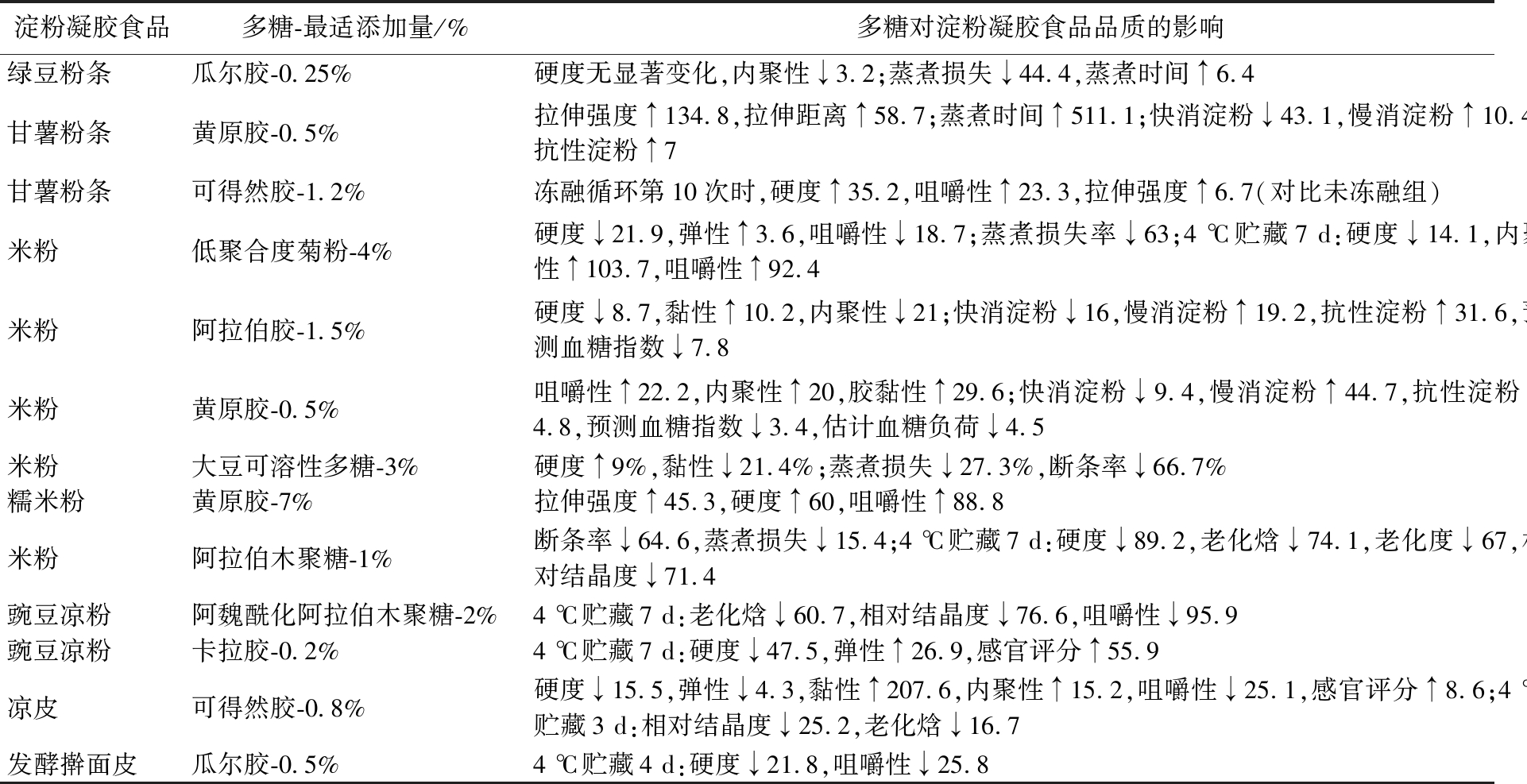
淀粉凝胶食品多糖-最适添加量/%多糖对淀粉凝胶食品品质的影响文献绿豆粉条瓜尔胶-0.25%硬度无显著变化,内聚性↓3.2;蒸煮损失↓44.4,蒸煮时间↑6.4[46]甘薯粉条黄原胶-0.5%拉伸强度↑134.8,拉伸距离↑58.7;蒸煮时间↑511.1;快消淀粉↓43.1,慢消淀粉↑10.4,抗性淀粉↑7[47]甘薯粉条可得然胶-1.2%冻融循环第10次时,硬度↑35.2,咀嚼性↑23.3,拉伸强度↑6.7(对比未冻融组)[48]米粉低聚合度菊粉-4%硬度↓21.9,弹性↑3.6,咀嚼性↓18.7;蒸煮损失率↓63;4 ℃贮藏7 d:硬度↓14.1,内聚性↑103.7,咀嚼性↑92.4[49]米粉阿拉伯胶-1.5%硬度↓8.7,黏性↑10.2,内聚性↓21;快消淀粉↓16,慢消淀粉↑19.2,抗性淀粉↑31.6,预测血糖指数↓7.8[50]米粉黄原胶-0.5%咀嚼性↑22.2,内聚性↑20,胶黏性↑29.6;快消淀粉↓9.4,慢消淀粉↑44.7,抗性淀粉↑4.8,预测血糖指数↓3.4,估计血糖负荷↓4.5[51]米粉大豆可溶性多糖-3%硬度↑9%,黏性↓21.4%;蒸煮损失↓27.3%,断条率↓66.7%[52]糯米粉黄原胶-7%拉伸强度↑45.3,硬度↑60,咀嚼性↑88.8[53]米粉阿拉伯木聚糖-1%断条率↓64.6,蒸煮损失↓15.4;4 ℃贮藏7 d:硬度↓89.2,老化焓↓74.1,老化度↓67,相对结晶度↓71.4[54]豌豆凉粉阿魏酰化阿拉伯木聚糖-2%4 ℃贮藏7 d:老化焓↓60.7,相对结晶度↓76.6,咀嚼性↓95.9[55]豌豆凉粉卡拉胶-0.2%4 ℃贮藏7 d:硬度↓47.5,弹性↑26.9,感官评分↑55.9[56]凉皮可得然胶-0.8%硬度↓15.5,弹性↓4.3,黏性↑207.6,内聚性↑15.2,咀嚼性↓25.1,感官评分↑8.6;4 ℃贮藏3 d:相对结晶度↓25.2,老化焓↓16.7[57]发酵擀面皮瓜尔胶-0.5%4 ℃贮藏4 d:硬度↓21.8,咀嚼性↓25.8[58]
在淀粉类凝胶食品质地方面,根据实际生产淀粉含量的差异,调整多糖的来源以及最适添加量,可获得高硬度、强咀嚼性能的粉条,或是质地较柔软的凉皮。如CAI等[53]研究发现黄原胶能显著改善糯米粉的拉伸强度、硬度、咀嚼性能,且黄原胶含量(1%~7%)与淀粉凝胶强度呈正相关。林致通[59]在凉皮的制作中添加黄原胶、阿拉伯胶(0.5%~1%),得到质地更加柔软的凉皮。同样地,将阿拉伯胶添加至米粉中,可能会表现出较低的硬度和内聚性[50],这与在淀粉凝胶模型中的研究一致。
在淀粉-多糖凝胶体系中,多糖有助于淀粉在回生过程中抗性淀粉的形成,从而调控淀粉类凝胶食品的营养特性。如FENG等[47]分别将黄原胶、海藻酸钠按照0.5%(质量分数)取代红薯淀粉制作湿粉条,研究发现,湿红薯粉条的快速消化淀粉含量降低,抗性淀粉含量得到提升。同样地,HUANG等[51]和GONG等[60]均研究发现多糖可以增加米粉抗性淀粉含量,减缓淀粉水解速率,从而降低淀粉消化率以及血糖生成指数。
大多数淀粉类凝胶食品在贮藏期间会因过度老化、失水而质地劣变。多糖的高保水性可以有效控制淀粉类凝胶食品的老化。如添加0.8%可得然胶显著延缓凉皮老化,相比于对照组,凉皮在4 ℃贮藏3 d后,硬度下降15.5%,咀嚼性下降25.1%,相对结晶度下降25.2%,老化焓下降16.7%[57]。同样地,菊粉用于鲜米粉抗老化的研究表明,低聚合度菊粉延缓鲜米粉老化的效果较好,可用于稳定贮藏期间米粉的品质,添加4%低聚合度菊粉,贮藏7 d的米粉相对于对照组硬度下降14.1%[49]。
除此之外,蒸煮特性(断条率、蒸煮损失)也是评价产品品质好坏的一个关键指标。基于多糖-淀粉复配体系中分子间相互作用的增强,粉条/米粉的断条率、蒸煮损失降低。SILVA等[61]分别将黄原胶、瓜尔豆胶添加在甘薯粉条体系中,结果表明粉条的蒸煮损失均得到一定改善。GUAN等[52]分别采用单螺杆和双螺杆挤压工艺制备米粉,在此基础上,研究大豆可溶性多糖对米粉品质的影响,结果表明3%(质量分数)大豆可溶性多糖可以显著降低米粉的蒸煮损失和断条率。由此可见,多糖在淀粉类凝胶食品的品质调控中具有显著优势。
5 结论与展望
综上所述,适量添加多糖可显著改善淀粉凝胶的质构特性、营养特性及贮藏稳定性。多糖调控效果不仅受淀粉原料特性的影响,还与多糖的结构、性质和浓度密切相关。本文基于近10年文献,重点分析多糖与淀粉间的相互作用机制,发现多糖通过其强亲水性以及与淀粉分子的非共价相互作用,调控淀粉凝胶三维网络结构,从而全面提升淀粉类凝胶食品品质。就凝胶的质构特性而言,大多数阴离子多糖和中性多糖能促进凝胶结构致密化,随相对分子质量和添加量的增加显著增强凝胶的强度、硬度和咀嚼性,而阳离子多糖和某些特殊结构多糖无法形成均匀连续的网状结构,降低凝胶硬度。多糖对淀粉凝胶消化特性的正向调控效应呈现出较强的规律性,随其添加量和相对分子质量的增加,凝胶体系抗性淀粉含量逐渐增加,预测血糖指数显著降低。此外,在贮藏稳定性方面,多糖的添加普遍能够延缓淀粉老化过程,表现为淀粉的相对结晶度随多糖添加量增加而下降,不同多糖因其结构不同延缓淀粉老化的作用方式略有不同。然而,大多数相关研究还停留在对淀粉凝胶模型的研究阶段,针对实际淀粉类凝胶食品的应用效果及其作用机制的系统研究相对不足。鉴于此,未来研究重点需从模型体系转向复杂实际食品体系,聚焦淀粉-多糖组分间相互作用与品质调控规律研究。
[1] 陈忠秋, 冯涛, 庄海宁, 等.香菇β-葡聚糖的提取及其对淀粉消化性的影响[J].食品科学, 2018, 39(10):71-77.CHEN Z Q, FENG T, ZHUANG H N,et al. Extraction of β-glucan from Lentinus edodes and its effect on starch digestibility[J].Food Science, 2018, 39(10):71-77.
[2] SONG J J, RONG L Y, LI J W, et al.Effects of three different polysaccharides on the sol gel-behavior, rheological, and structural properties of tapioca starch[J].International Journal of Biological Macromolecules, 2024, 254:128053.
[3] YAN W J, ZHANG M H, ZHANG M, et al.Effect of wheat bran arabinoxylan on the gelatinization and long-term retrogradation behavior of wheat starch[J].Carbohydrate Polymers, 2022, 291:119581.
[4] RONG L Y, SHEN M Y, WEN H L, et al.Effects of xanthan, guar and Mesona chinensis Benth gums on the pasting, rheological, texture properties and microstructure of pea starch gels[J].Food Hydrocolloids, 2022, 125:107391.
[5] JI X L, YIN M S, HAO L R, et al.Effect of inulin on pasting, thermal, rheological properties and in vitro digestibility of pea starch gel[J].International Journal of Biological Macromolecules, 2021, 193:1669-1675.
[6] CUI Y M, HAN X D, HUANG X, et al.Effects of different sources of β-glucan on pasting, gelation, and digestive properties of pea starch[J].Food Hydrocolloids, 2023, 135:108172.
[7] ZHOU R, WANG Y J, WANG Z X, et al.Effects of Auricularia auricula-judae polysaccharide on pasting, gelatinization, rheology, structural properties and in vitro digestibility of kidney bean starch[J].International Journal of Biological Macromolecules, 2021, 191:1105-1113.
[8] XUE H K, GAO H Y, FANG S S, et al.Understanding the role of Radix Paeoniae Alba polysaccharide for corn starch gel amelioration:Physicochemical, structural, and digestive properties[J].International Journal of Biological Macromolecules, 2025, 295:139564.
[9] HAN X, LIANG Q F, RASHID A, et al.The effects of different hydrocolloids on Lotus root starch gelatinization and gels properties[J].International Journal of Biological Macromolecules, 2024, 257:128562.
[10] PAN W T, QI X, HUANG Z B, et al.Effect of three polysaccharides with different charge characteristics on the properties of highland barley starch gel[J].International Journal of Biological Macromolecules, 2024, 281:136267.
[11] LIU W M, WANG R R, LI J W, et al.Effects of different hydrocolloids on gelatinization and gels structure of chestnut starch[J].Food Hydrocolloids, 2021, 120:106925.
[12] LV X Y, RONG L Y, ZHANG W D, et al.Pasting, structural properties, and in vitro digestibility of water chestnut (Eleocharis dulcis Burm.F., Cyperaceae) starch co-gelatinized with different hydrocolloids[J].Food Hydrocolloids, 2025, 160:110777.
[13] 赵胜男, 梅新, 黄师荣, 等.海藻酸钠和黄原胶对橡子淀粉热特性及凝胶特性的影响[J].中国粮油学报, 2025, 40(3):94-102.ZHAO S N, MEI X, HUANG S R, et al.The effects of sodium alginate and xanthan gum on the thermal and gel properties of acorn starch[J].Journal of the Chinese Cereals and Oils Association, 2025, 40(3):94-102.
[14] XIE H, YING R F, HUANG M G.Effect of arabinoxylans with different molecular weights on the gelling properties of wheat starch[J].International Journal of Biological Macromolecules, 2022, 209:1676-1684.
[15] GONG X, LI J X, LIU Z G, et al.Effects of Psyllium polysaccharide with different molecular weights on the digestibility, physicochemical properties of rice starch, and interaction forces between them[J].International Journal of Biological Macromolecules, 2025, 309(Pt 2):142911.
[16] YURIS A, GOH K K T, HARDACRE A K, et al.Understanding the interaction between wheat starch and Mesona chinensis polysaccharide[J].LWT, 2017, 84:212-221.
[17] YOSHIMURA M, TAKAYA T, NISHINARI K.Rheological studies on mixtures of corn starch and konjac-glucomannan[J].Carbohydrate Polymers, 1998, 35(1-2):71-79.
[18] YANG F, DU Q L, MIAO T, et al.Interaction between potato starch and Tremella fuciformis polysaccharide[J].Food Hydrocolloids, 2022, 127:107509.
[19] ZHANG Y, WANG Y M, YANG B J, et al.Effects of zucchini polysaccharide on pasting, rheology, structural properties and in vitro digestibility of potato starch[J].International Journal of Biological Macromolecules, 2023, 253:127077.
[20] XIAO Y H, LIU S C, SHEN M Y, et al.Effect of different Mesona chinensis polysaccharides on pasting, gelation, structural properties and in vitro digestibility of tapioca starch-Mesona chinensis polysaccharides gels[J].Food Hydrocolloids, 2020, 99:105327.
[21] ZHOU R, KANG Y H.Synergistic interaction of Auricularia auricula-judae polysaccharide with yam starch:Effects on physicochemical properties and in vitro starch digestibility[J].Food Science and Biotechnology, 2018, 27(6):1579-1588.
[22] CHEN L, TIAN Y Q, ZHANG Z P, et al.Effect of pullulan on the digestible, crystalline and morphological characteristics of rice starch[J].Food Hydrocolloids, 2017, 63:383-390.
[23] ZHUANG H N, CHEN Z Q, FENG T, et al.Characterization of Lentinus edodes β-glucan influencing the in vitro starch digestibility of wheat starch gel[J].Food Chemistry, 2017, 224:294-301.
[24] FENG T, SHUI M Z, CHEN Z Q, et al.Hericium erinaceus β-glucan modulates in vitro wheat starch digestibility[J].Food Hydrocolloids, 2019, 96:424-432.
[25] TU J C, ADHIKARI B, BRENNAN M A, et al.Acidic polysaccharides from black ear and silver ear mushrooms modulated the release and transport of glucose from gelatinised sorghum starch during digestion[J].Food Chemistry, 2023, 411:135426.
[26] GAO J Y, ZHU L, HUANG J, et al.Effect of dandelion root polysaccharide on the pasting, gelatinization, rheology, structural properties and in vitro digestibility of corn starch[J].Food &Function, 2021, 12(15):7029-7039.
[27] ZHANG H, LI Z, TIAN Y J, et al.Interaction between barley β-glucan and corn starch and its effects on the in vitro digestion of starch[J].International Journal of Biological Macromolecules, 2019, 141:240-246.
[28] XUE H K, GAO H Y, WANG Y, et al.Effects of Rhizoma Anemarrhenae polysaccharide on the physicochemical and digestive properties of corn starch[J].Lwt, 2025, 215:117258.
[29] NIU G G, YOU G, LIU X L.Interactions of hsian-tsao polysaccharide with corn starch to reduce its in vitro digestibility[J].International Journal of Biological Macromolecules, 2024, 265:130951.
[30] KONG X R, ZHU Z Y, ZHANG X J, et al.Effects of Cordyceps polysaccharides on pasting properties and in vitro starch digestibility of wheat starch[J].Food Hydrocolloids, 2020, 102:105604.
[31] SASAKI T, KOHYAMA K.Effect of non-starch polysaccharides on the in vitro digestibility and rheological properties of rice starch gel[J].Food Chemistry, 2011, 127(2):541-546.
[32] CHEN L, REN F, ZHANG Z P, et al.Effect of pullulan on the short-term and long-term retrogradation of rice starch[J].Carbohydrate Polymers, 2015, 115:415-421.
[33] 柳艳梅, 左小博, 房升, 等.亲水性胶体对大米淀粉流变与回生性的影响[J].食品科学, 2017, 38(1):47-52.LIU Y M, ZUO X B, FANG S, et al.Effect of hydrocolloids on the rheology and retrogradation of rice starch[J].Food Science, 2017, 38(1):47-52.
[34] CUI X W, GUAN C B, WANG H Q, et al.Chlamydomonas reinhardtii polysaccharides retard rice starch retrogradation by weakening hydrogen bond strength within starch double helices[J].International Journal of Biological Macromolecules, 2025, 296:139570.
[35] LUO D L, LI Y, XU B C, et al.Effects of inulin with different degree of polymerization on gelatinization and retrogradation of wheat starch[J].Food Chemistry, 2017, 229:35-43.
[36] ZHANG K L, LI X W, LI J J, et al.Tunable controlling the retrogradation rate of wheat starch using different fractions of Artemisia sphaerocephala Krasch polysaccharide[J].Bioactive Carbohydrates and Dietary Fibre, 2021, 26:100272.
[37] ZHOU J J, JIA Z Y, WANG M, et al.Effects of Laminaria japonica polysaccharides on gelatinization properties and long-term retrogradation of wheat starch[J].Food Hydrocolloids, 2022, 133:107908.
[38] HOU C D, ZHAO X H, TIAN M Q, et al.Impact of water extractable arabinoxylan with different molecular weight on the gelatinization and retrogradation behavior of wheat starch[J].Food Chemistry, 2020, 318:126477.
[39] WANG J X, ZHANG S S, WANG N, et al.Tremella polysaccharide has potential to retard wheat starch gel system retrogradation and mechanism research[J].Foods, 2023, 12(16):3115.
[40] ZHAO Q Z, TIAN H, CHEN L, et al.Interactions between soluble soybean polysaccharide and starch during the gelatinization and retrogradation:Effects of selected starch varieties[J].Food Hydrocolloids, 2021, 118:106765.
[41] LI Z H, DUAN Q F, MO Y M, et al.Effects of Alpinia oxyphylla fructus polysaccharide on the gelatinization, retrogradation, structural characteristics, antioxidant activity, and in vitro digestibility of corn starch[J].International Journal of Biological Macromolecules, 2025, 310:143284.
[42] WANG L B, ZHU L, GAO J Y, et al.Effect of dandelion root polysaccharide on structure, rheology and retrogradation properties of corn starch during storage[J].International Journal of Food Science &Technology, 2022, 57(10):6522-6530.
[43] FUNAMI T, KATAOKA Y, OMOTO T, et al.Effects of non-ionic polysaccharides on the gelatinization and retrogradation behavior of wheat starch[J].Food Hydrocolloids, 2005, 19(1):1-13.
[44] ZHAO K F, JIA Z Y, HOU L L, et al.Study on physicochemical properties and anti-aging mechanism of wheat starch by anionic polysaccharides[J].International Journal of Biological Macromolecules, 2023, 253:127431.
[45] ZHANG B, BAI B, PAN Y, et al.Effects of pectin with different molecular weight on gelatinization behavior, textural properties, retrogradation and in vitro digestibility of corn starch[J].Food Chemistry, 2018, 264:58-63.
[46] KAUR A, SHEVKANI K, SINGH N, et al.Effect of guar gum and xanthan gum on pasting and noodle-making properties of potato, corn and mung bean starches[J].Journal of Food Science and Technology, 2015, 52(12):8113-8121.
[47] FENG Y Y, MU T H, ZHANG M, et al.Effects of different polysaccharides and proteins on dough rheological properties, texture, structure and in vitro starch digestibility of wet sweet potato vermicelli[J].International Journal of Biological Macromolecules, 2020, 148:1-10.
[48] LI X Y, LIU S, NIU L Y, et al.Improvement in quality of frozen sweet potato starch vermicelli during freeze-thaw cycles by curdlan addition and its mechanism[J].Lwt, 2024, 214:117161.
[49] YE Y, LIAO L Y, YANG R X, et al.Inhibitory effect of different degree of polymerization inulin on the retrogradation of rice starch gels and fresh rice noodles[J].Lwt, 2024, 213:117001.
[50] YOUNG B, KYUNG O, SOL J, et al.Influence of arabic gum on in vitro starch digestibility and noodle-making quality of Segoami[J].International Journal of Biological Macromolecules, 2019, 125:668-673.
[51] HUANG S X, CHI C D, LI X X, et al.Understanding the structure, digestibility, texture and flavor attributes of rice noodles complexation with xanthan and dodecyl gallate[J].Food Hydrocolloids, 2022, 127:107538.
[52] GUAN C M, LIU J J, GAN S L, et al.Effects of soluble soybean polysaccharide on cooking and eating quality of dry rice noodles under single- and twin-screw extrusions[J].LWT, 2023, 187:115352.
[53] CAI J W, CHIANG J H, TAN M Y P, et al.Physicochemical properties of hydrothermally treated glutinous rice flour and xanthan gum mixture and its application in gluten-free noodles[J].Journal of Food Engineering, 2016, 186:1-9.
[54] 李佳洋, 王馨远, 殷丽君, 等.小麦水溶性阿拉伯木聚糖对大米粉加工特性及鲜湿米粉食用品质的影响[J].食品工业科技, 2025, 46(5):56-62.LI J Y, WANG X Y, YIN L J, et al.Effects of wheat water-extractable arabinoxylanon on the processing properties of rice flour and eating quality of fresh rice noodles[J].Science and Technology of Food Industry, 2025, 46(5):56-62.
[55] WANG J Y, YU Z W, ZHANG X, et al.Effect of feruloylated arabinoxylan on the retrogradation and digestibility properties of pea starch during short-term refrigeration:Dependence of polysaccharide structure and bound ferulic acid content[J].International Journal of Biological Macromolecules, 2024, 257:128524.
[56] 王玲, 蓝绪悦, 徐文, 等.品质改良剂延缓即食豌豆凉粉老化研究[J].食品科技, 2021, 46(8):227-232.WANG L, LAN X Y, XU W, et al.Anti-retrogradation of instant pea jelly by quality improvers[J].Food Science and Technology, 2021, 46(8):227-232.
[57] 伏佳静, 马珂莹, 蒲华寅, 等.可得然胶改善凉皮冷藏保存品质的机理研究[J].食品与生物技术学报, 2022, 41(11):90-97.FU J J, MA K Y, PU H Y, et al.Mechanism of curdlan to improve liangpi quality during refrigeration[J].Journal of Food Science and Biotechnology, 2022, 41(11):90-97.
[58] 范欣. 发酵和添加亲水胶体对小麦淀粉结构和擀面皮品质影响研究[D].西安:陕西师范大学, 2022.FAN X.Study on the effects of fermentation and addition of hydrocolloids on wheat starch structure and wheat starch-based noodle[D].Xi’an:Shaanxi Normal University, 2022.
[59] 林致通. 凉皮食用品质标准建立和方便凉皮生产技术研究[D].重庆:西南大学, 2020.LIN Z T.Establishment of liangpi edible quality standards and research on convenient liangpi production technology[D].Chongqing:Southwest University, 2020.
[60] GONG X, LI J X, LIU Z G, et al.Developing high resistant starch content rice noodles with superior quality:A method using modified rice flour and Psyllium fiber[J].International Journal of Biological Macromolecules, 2024, 272:132779.
[61] SILVA E, BIRKENHAKE M, SCHOLTEN E, et al.Controlling rheology and structure of sweet potato starch noodles with high broccoli powder content by hydrocolloids[J].Food Hydrocolloids, 2013, 30(1):42-52.